Posts

The Tricycle: Endemically Pinoy

Image
Some people consider this a nuisance because of the noise they create. You can hear them coming towards you from a few blocks away, which can be good news if you are waiting for one, but bad news if you are trying to read a book or watch a really good movie. The tricycle is the most common form of transportation in small towns and inside subdivisions and villages. It is the common motorcycle, not the big bikes of the Harley-Davidson type, but the typical two-passenger motorcycle where a side-car is attached. The simplest type can accomodate only 3 people, while in other areas, the sidecars can accomodate 7 because some drivers make contortionists out of their passengers, especially the long-limbed foreigner.

Fruit in Season: Santol (Sandor Fruit)

Image
The very thought of eating santol makes my mouth water, not because it is tasty in the classic way, or the ideal way that people describe tasty, but because its taste can range from really sour, to just sour and to sweet, depending on which part of the fruit you are eating, also. To eat santol, the skin should be pared of thinly to uncover a thick pinkish pulp that becomes purple when exposed. Even if it is soaked in water, after sometime, that area beneath the thin skin covering still turns purple. Some people love to eat this part of the fruit (but no thanks, I cant bear its acidity) now, here is the interesting part. After eating all that pulp, you will see 5 big seeds. No matter how you try to resist to not swallow the big santol seeds, your resistance will crumble as the seeds are the sweetest and most delicious part of the santol. I just cant help but swallow them. I remember being warned by the old folks that the seeds should not be swallowed otherwise a santol plant will...

WOW Showcases Northern Mindanao in Pasundayag at the CLAMSHELL 1 in Intramuros from May 27 to June 14, 2009

Image
Northern Mindanao, which is composed of the provinces of Misamis Occidental, Misamis Oriental, Camiguin and Bukidnon as well as the cities of Iligan, Cagayan de Oro and Gingoog is currently the region being featured in Clamshell 1, in Intramuros. Having spent the first 17 years of my life in Mindanao, I consider it my home. I am proud of the abundant resources, breathtaking naturescapes, laid-back culture and the simplicity of life that make Mindanao deserving to be called the Land of Promise. Here are snapshots from the exhibit. Indigenous groups and their activities A beadmaker from the Umayam tribe of Bukidnon. She was intently and quietly making headwear and other accessories from beads so I decided not to interrupt her, would have wanted to engage in a short chitchat with her, but still there was the language problem. Umayam kids in traditional and colorful garments make cute models too. A member of the Talaandig group gladly posed with us, after performing a native dance for ...

Fruit in Season: Avocado

Image
It's the avocado season once again, time to make that guacamole dip and avocado flavored ice cream. According to an expert, the best variety is the lagkitan as it is moist, smooth and compact and ideal for deserts. Dont buy the variety that has plenty of black veins as they are not pleasant tasting. Enjoy your avocado treats now. Here is a simple guacamole recipe shared to me by a Peace Corps Volunteer: who modified the ingredients in favor of the local resources. Slice a medium sized avocado and mash it. Chop the following finely: a small head of onion, 2 cloves of garlic and mix thoroughly with the mashed avocado. Squeeze one calamansi and season with black pepper and salt.

The Sights and Sounds of Quiapo

Image
Quiapo is perhaps one of the busiest districts in Metro Manila, if not THE busiest. To one who does not frequent the place, going around it is an eye-opener about the way of life of the people and economy within the area. Quiapo Church is the focal point of the district and the Friday mass is the number one crowd-drawer. But the main thing that it is famous for is the Feast of the Black Nazarene, which is held in the month of January. But that is a topic for another blog. After my fall-in-line-till-you-drop day at the DFA, my feet dragged me to Quiapo. After not seeing it for over a year, I find it amazing that life remains the same to the mainstays here. It is as if it is still the 1900s. Save for this concrete canopy-like structure that covers the entrance to the underpass, Quiapo is stagnant. Although it is kind of like preserving the memories of Manila in the past and its historical legacies, i.e. Plaza Miranda and it's bombing. Quiapo is the melting pot of folk-Catho...

The Lone Authentic Ifugao of Barangay Banga-an

Image
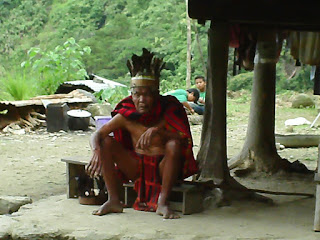
Our difficult trek to Banga-an, a small barangay in Banawe, Ifugao, was rewarded upon seeing this lone authentic Ifugao gentleman who we caught chewing a betel nut under one of the huts (probably his own). We were disappointed at first when we noticed that almost all people living in this barangay no longer wear their traditional clothing, so it was a pleasure for us to see this authentic Ifugao in his traditional garb. As not one of us could speak Ifugao, we could not converse with him, but according to the neighbors, he is slightly deaf. From the Greenview Hotel where we were billeted, we could see the Banawe Rice Terraces in all its grandeur. But at that time, the vegetation was not as thick as it would be during the rainy months. We arranged for a local jeepney with a guide whose name is Manong Johny, it cost us P2,000 and P700 for the guide. The ratio of a tour guide to the number of tourists is 7:1 or thereabouts. But if you are travelling on a budget, you may just hike goin...

But I see Peanuts

Image
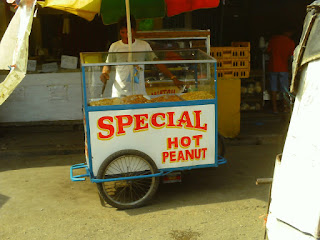
The Hot Peanut Cart, which can be seen in practically every corner and every barangay in Manila and the Philippines for that matter, is an example of the unique English of the Filipinos and the "gaya-gaya" culture.